


Technology, collaboration and an “engagement first” approach are helping the Homeless Trust address homeless encampments - without arrest. Following the passage of House Bill 1365, the Homeless Trust is working closer than ever with local and county governments to effectively and humanely respond to reports of unauthorized camping and sleeping on public property. The cornerstone of this enhanced outreach and collaboration is a new Homeless Reporting Tool (HRT).
Envisioned by the Homeless Trust’s executive team and brought to life by the County’s IT Department, HRT connects to the geographic information system (GIS) software that enables mapping, spatial analysis, and data management. Reports to the HRT provide immediate connection and deployment of Homeless Trust-funded mobile outreach teams, which are geographically assigned to zones across Miami-Dade County and serve as first responders to any complaint or concern. Outreach teams engage homeless individuals promptly and humanely, offering support and a menu of services that provide an alternative to sidewalks and park benches. The HRT is the most powerful new tool to help the county, service providers, and outreach teams work together to improve the quality of life for all.
Here's how it works:
When a report about an encampment or an individual experiencing homelessness is entered in the HRT, the tool quickly routes the information to trained outreach teams. Those teams engage people living on the streets in a trauma-informed way, offering housing and service options, while coordinating with local agencies to address any site issues.
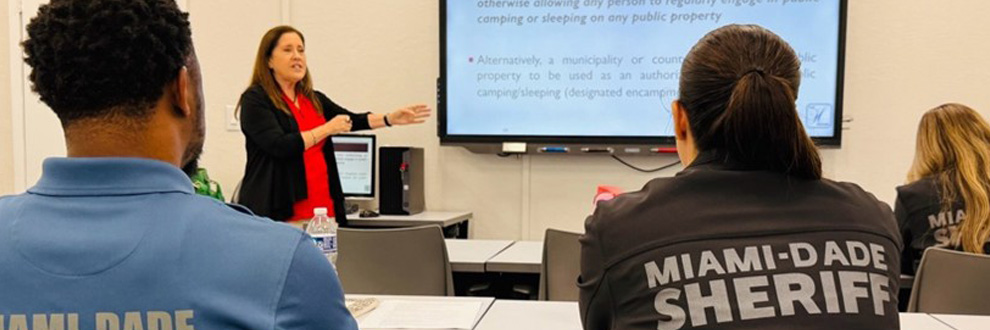
After its launch in January 2025, 544 unduplicated reports were logged into the HRT through December 31, allowing outreach teams to respond quickly and consistently across Miami-Dade County. Multiple county departments are working in historically new ways to coordinate information, including Solid Waste Management, Parks, Recreation and Open Spaces, Transit and Public Works, and Regulatory and Economic Resources. The Trust has provided access to the HRT to more than 280 individuals and trained all its partners, including the Miami-Dade Sheriff’s Office District Neighborhood Resource Unit staff and more than a dozen municipal police departments, to ensure buy-in and consistent data reporting. The robust data collected from the HRT made the 2026 Point-in-Time census of unsheltered homeless the most accurate count to date.
“The Homeless Reporting Tool represents a uniquely local solution to responding quickly to the homeless and helping our unsheltered avoid arrests that can be so detrimental to their ability to find jobs, housing and the ability to address other needs,” said Ron Book, Chair of the Miami-Dade County Homeless Trust. “This solution was created at the initiative of the Homeless Trust to combine technology, collaboration and compassionate outreach to foster greater communication between key partners. The result is compliance with HB1365. It’s one more example of how this community is leading the way on effective homeless outreach models and setting a new standard for continuums around the U.S.”